 Symtrail
Fever log for children: what to write down
A fever log is the simplest record a parent can keep, and one of the most useful. Here's what to put in it, and a chart you can print and stick on the fridge.
Updated · 5 min read
In short: each line of a fever log should have the date and time, the temperature, how it was measured, any medicine and dose given, and a few words on symptoms and how your child seems. That's enough for you to spot trends, and for a doctor to understand what happened.
Why keep a fever log at all?
- Doses. When two adults are taking turns through the night, a written log is the only reliable way to know when the last medicine was given.
- The doctor's questions. "How high has it been? How long has it lasted? When did you last give something?" are easy to answer from a log and hard to answer from memory at 9am after a bad night.
- Trends. Is the fever coming down day by day, or not? A column of numbers shows it.
- Patterns over months. If fevers keep coming back, a log of each episode is how you spot a recurring pattern.
What each column is for
Date and time
The single most important column. Write the time to the nearest quarter-hour, especially at night.
Temperature
The number, with the unit. A temperature of 38°C (100.4°F) or above is commonly treated as a fever.
How it was measured
Ear, forehead, armpit or mouth. Readings from different methods differ a little, so this stops you from mistaking a change of thermometer for a change in your child.
Medicine and dose
The name, the amount and the time — for example "paracetamol 5 ml, 02:15". Always follow the instructions on the packet or from your pharmacist or doctor; the log just keeps track of what you actually gave.
Symptoms and notes
A few words: "drinking well", "sore throat, rash on chest", "sleepy, hard to wake". If something changes or worries you, note what and when.
Printable fever chart
Print this out and keep it somewhere obvious, with a pen. It's designed to fit a single A4 or US Letter page.
Fever log
| Date | Time | Temp. | Medicine & dose | Symptoms / notes |
|---|---|---|---|---|
38°C = 100.4°F. This chart is for keeping a record only and is not medical advice. symtrail.com
Keeping the log on your phone instead
Paper works, but it gets lost, it isn't with you at the surgery, and it can't tell you anything. A phone log fixes all three.
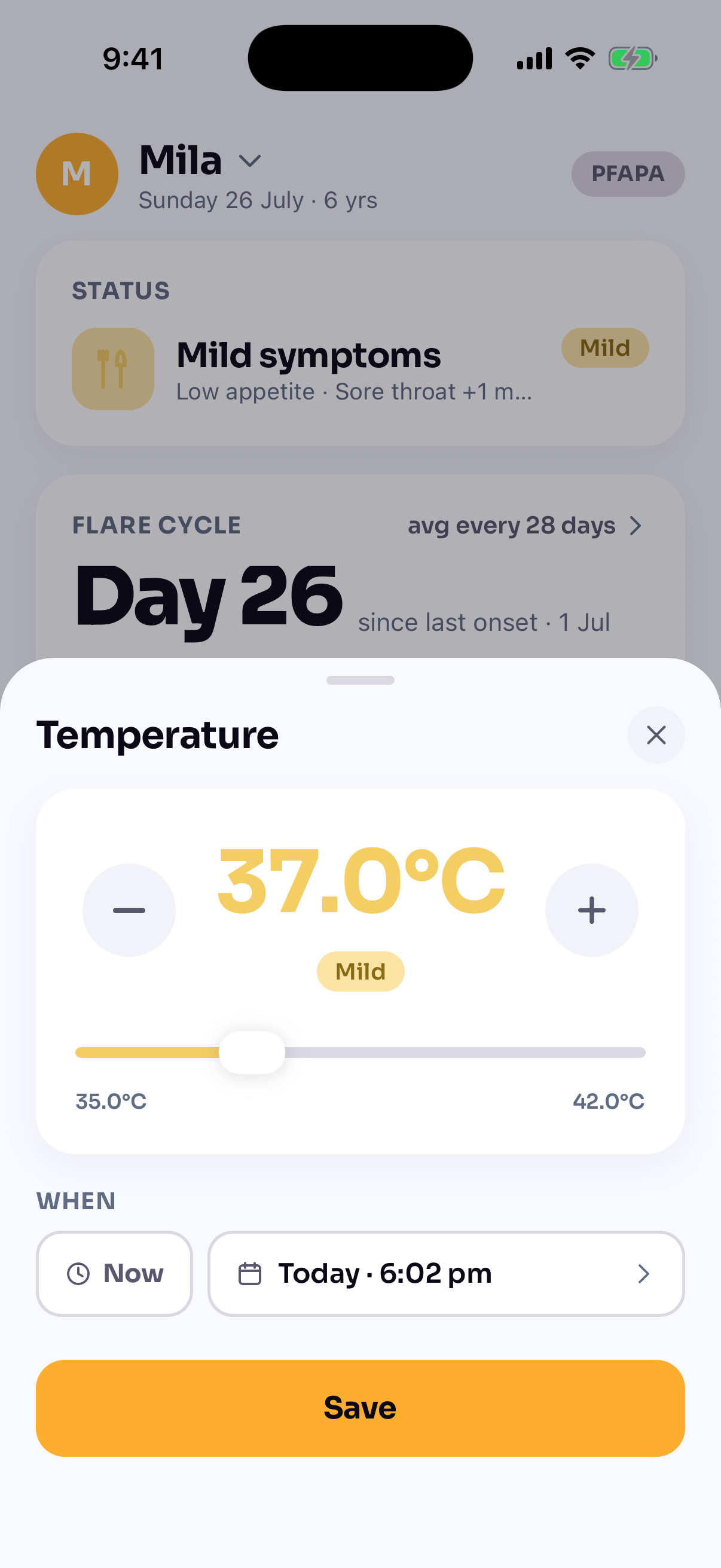
Everything stays on your phone: there's no account and nothing is uploaded. When you need to show a doctor, Symtrail turns the log into a PDF report, generated on your phone.
This page is about keeping a record, not about when a fever needs treatment. If your child seems very unwell, is a young baby with a fever, or you're worried, contact a doctor or your local emergency number.
Questions
Common questions
How often should I take my child's temperature during a fever?
There's no need to wake a sleeping child just to take a reading. For a log, a few readings a day — plus one whenever something changes — is plenty. Follow any instructions your doctor has given you.
Does it matter which thermometer I use?
Different methods give slightly different readings, so note which one you used and stick with it where possible. That keeps the numbers in your log comparable from day to day.
Should I record temperatures in Celsius or Fahrenheit?
Either, as long as you're consistent. 38°C is 100.4°F, the threshold commonly used for a fever. Symtrail lets you choose the unit and converts everywhere it's shown.
Can I print the fever log?
Yes. Use the Print button on this page — only the chart prints, on a single A4 or Letter page, with nothing else around it.
Keep reading
More guides for parents
Or keep the fever log on your phone
Symtrail is a free symptom, temperature and medicine diary for your child. No account, works offline, and nothing you log ever leaves your phone.
Free to download. No account, no ads.