 Symtrail
How to keep a symptom diary for your child's doctor
Most appointments are over in ten minutes. A good symptom diary means those minutes are spent on your child, not on trying to remember what happened three weeks ago.
Updated · 6 min read
In short: record each symptom with the date, time, how severe it was and how long it lasted, plus temperatures and medicines. Before the appointment, boil it down to a one-page summary: what's happening, since when, how often, what you've tried, and the two or three questions you most want answered. Bring the detail as backup.
Why a diary changes the appointment
Many childhood problems come and go: fevers, rashes, tummy aches, headaches, coughs that are worse at night. By the time you're sitting in front of the doctor, your child may be completely well, and the doctor has only your description to go on.
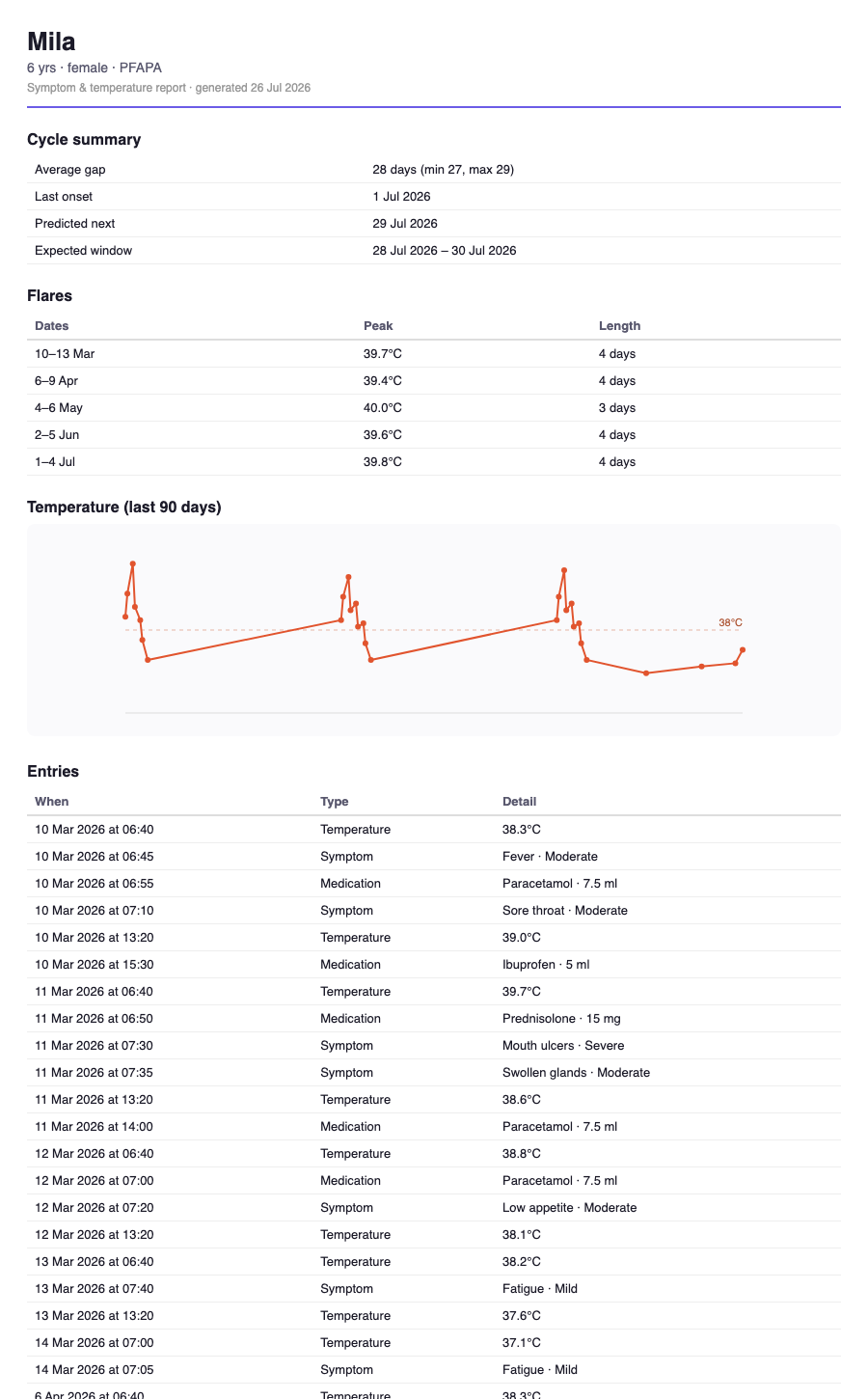
A diary turns that description into something concrete. "She's had five fevers since March, each three to four days long, roughly four weeks apart, peaking around 39.5°C" gives a doctor a lot more to work with than "she keeps getting ill".
What to record day to day
- The symptom, in plain words. Be specific: "pain around the belly button" rather than "tummy ache".
- When it started and how long it lasted.
- How bad it was — a simple mild / moderate / severe scale is fine, as long as you use it consistently.
- Temperatures, with times. See our fever log guide for a printable chart.
- Medicines given, doses and times, and whether they helped. Our medicine log guide covers this in more detail.
- Anything that might be connected — food, sleep, nursery, a new soap, illness in the family.
- Photos of anything visible, dated.
Keep it short. A line or two per entry, logged at the time, is far more useful than a long entry written from memory a few days later.
Before the appointment: make a one-page summary
A doctor can't read six weeks of notes in a ten-minute slot. Spend a few minutes the night before turning your diary into one page:
- The main problem, in one sentence. "Recurring high fevers with mouth ulcers since March."
- The timeline. When it started, how often it happens, how long each episode lasts. A short table works well.
- The numbers. Highest temperatures, number of episodes, gaps between them.
- What you've tried and whether it helped.
- How your child is in between.
- Your questions — two or three, written down, most important first.
On the day
- Hand over the summary at the start, rather than saving it for the end.
- Have the detail ready — on paper or on your phone — for when the doctor asks about a particular episode.
- Bring the medicines, or photos of their labels, if there's any doubt about names or strengths.
- Write down what the doctor says, including anything you should watch for and when to come back. Add it to the diary when you get home.
After the appointment
Keep going. If the doctor suggests trying something, the diary is how you'll both know whether it worked. If they suggest waiting and watching, the diary is what you'll bring next time. And if you're tracking fevers that keep coming back, read our guide to spotting a pattern in recurring fevers.
A symptom diary helps you describe what you've seen. It isn't a diagnosis, and it isn't a reason to wait if you're worried — if your child seems very unwell, contact a doctor or your local emergency number.
Questions
Common questions
Do doctors actually want to see a symptom diary?
A short, clear one, generally yes — especially for problems that come and go, where the doctor won't see the symptoms in the room. Lead with a one-page summary and keep the detail available if they want it.
How far back should the diary go?
As far back as the problem goes, if you have it. For recurring problems, several episodes are much more useful than one. If you're starting now, start today — even a couple of weeks of notes beats none.
Should I include photos?
For things that come and go — a rash, a swelling, mouth ulcers — a dated photo can be very useful, because it may have disappeared by the time of the appointment.
Is a diary from an app as good as a paper one?
The content is what matters. An app has the advantage of timestamps, charts and a summary built for you. Symtrail produces a PDF report you can share or show on your phone.
Keep reading
More guides for parents
Make the report in one tap
Symtrail is a free symptom, temperature and medicine diary for your child. No account, works offline, and nothing you log ever leaves your phone.
Free to download. No account, no ads.